
21 June 2026
Nostalgia can be dangerous. Nostalgia, argues Gillo Dorfles, lies at the heart of some of the most reactionary aesthetics and political projects of the modern era. Fascism and Nazism drew their emotional force from idealised visions of a lost imperial past, constructing mythologies through selective historical memory, false rituals and decontextualised symbols—also known as kitsch. Contemporary far-right movements continue to deploy similar strategies, invoking a mythical national past in an attempt to reconstruct “a world that never existed”, in the words of Vincenzo Estremo.
Yet nostalgia is not reducible to political manipulation. Rebecca Moccia’s exhibition Nostalgism at Temple Bar Gallery + Studios (15 May – 28 June 2026) embraces and challenges nostalgia as a condition: a complex relationship between memory, place and belonging.
Moccia departs from the 1944 Vesuvius eruption and its impact on Naples, her family’s hometown. The eruption transformed both landscape and social life, becoming embedded in the collective memory and shaping the national identity of Neapolitans.
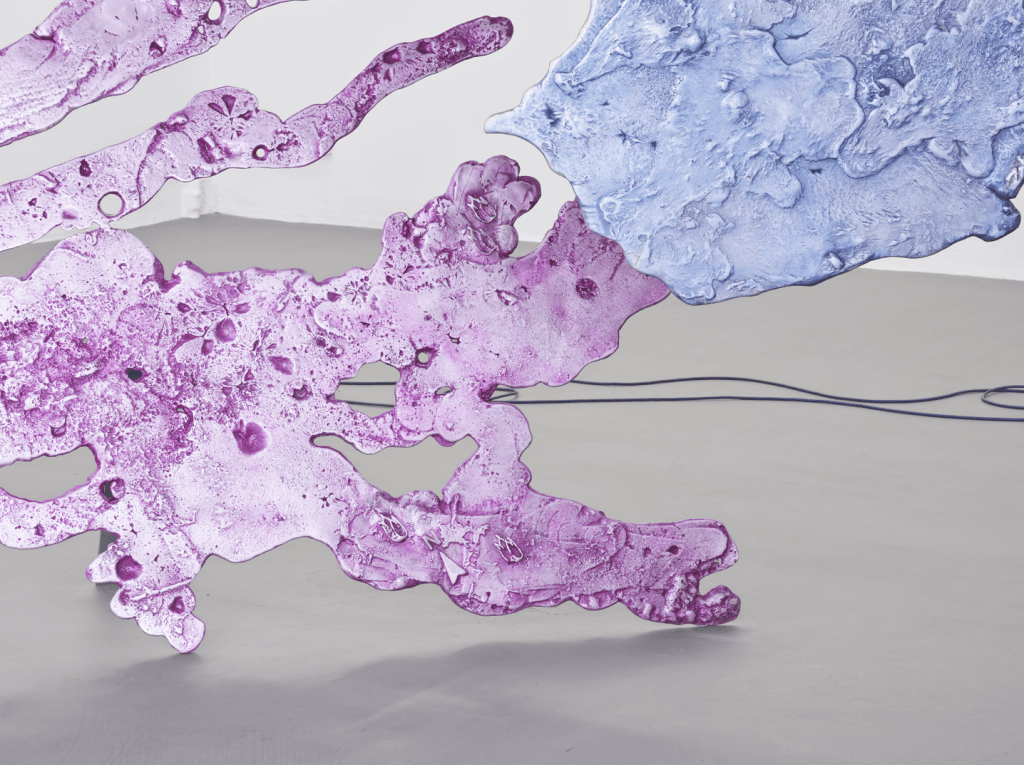
Installed in the gallery’s left wing, Ancestor Syndrome consists of cast aluminium plaques replicating fragments of a geological map documenting the Vesuvius crater and lava flows.
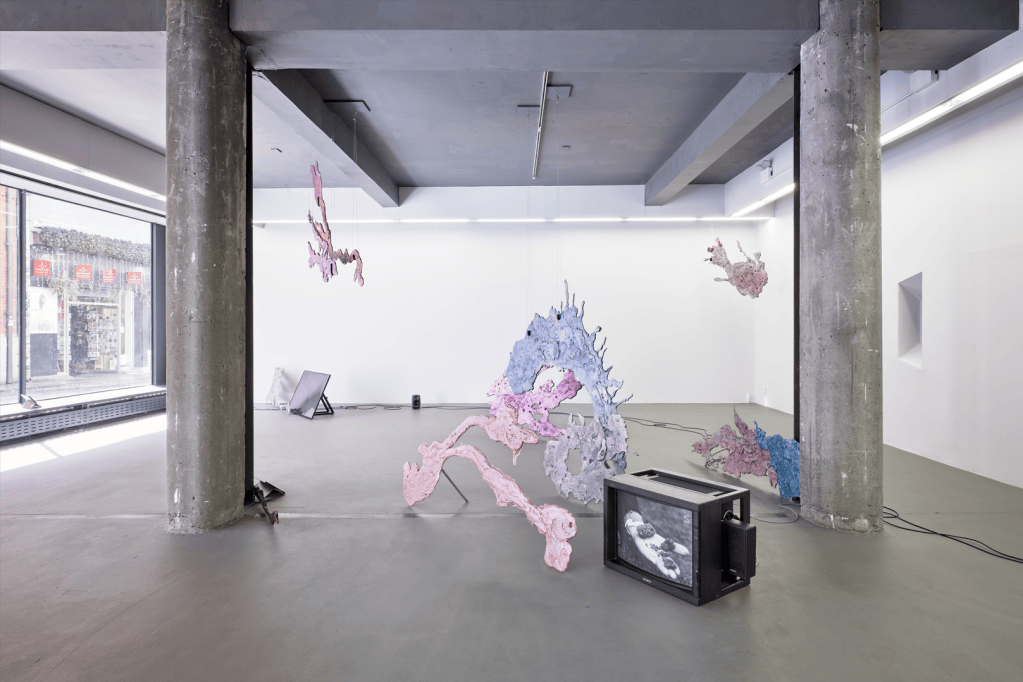
Cartography operates here as a material record of belonging. an agent of materialising a geographical sense of belonging and visualising strategic historical events that redesign national identity. The plaques’ pale lilac surfaces contrast with the greys of volcanic ash and stone that become souvenirs.
At the centre of the exhibition is a multi-channel installation composed of eight analogue and digital screens of varying sizes. Drawing on archival footage from the BBC and the Archivio Audiovisivo el Movimiento Operaio e Democratico, alongside Moccia’s own recordings filming the back of her family walking the modern streets of Naples.
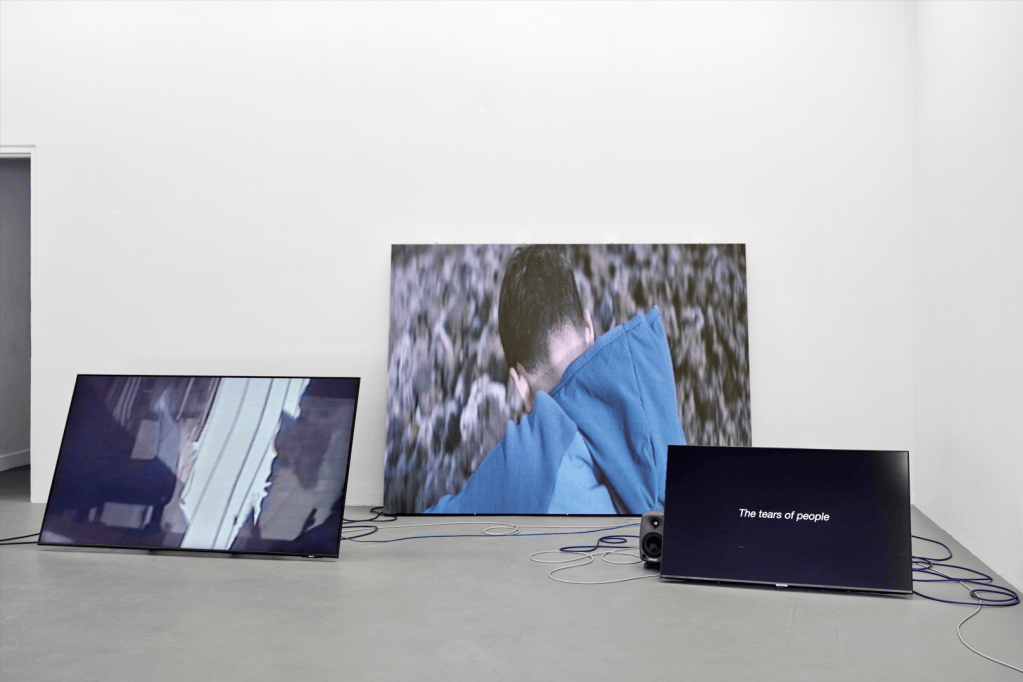
The juxtaposition of archival and contemporary footage recalls recent investigations of nostalgia within Irish contemporary art, particularly Eoghan Ryan’s Carceral Jigs (2025). While Ryan explored how nostalgic imagery can be utilised to build twisted nationalistic discourse—where nostalgia becomes a political danger— Moccia approaches nostalgia through the intimate terrain of family memory and place.
The footage often synchronizes with the poetic text of Vincenzo Estremo. The narration, moving between the anecdotal and the historical, appears in short, fragmented sentences, almost like parliaments.
“Once I left, I kept on looking for a familiar landscape.” Familiarity as a safe space; the commodity of the “known”, transformed into a souvenir.
“What cannot be seen is the image of Naples that remains. The one made by its own people, before the gazes of others distorted it.” Here emerges a tension between memory and representation: a longing for Naples before it was perverted by neoliberal into a mass-tourism destination. “Millions of tourists looking out without eyes to actually see.”
“Nostalgic southerners.” We are accused of this condition. We look at our own crater, burial sites, and the backs of our families’ necks as they walk through historical alleyways as if they were already scenes of a lost time. We are marked by homesickness.
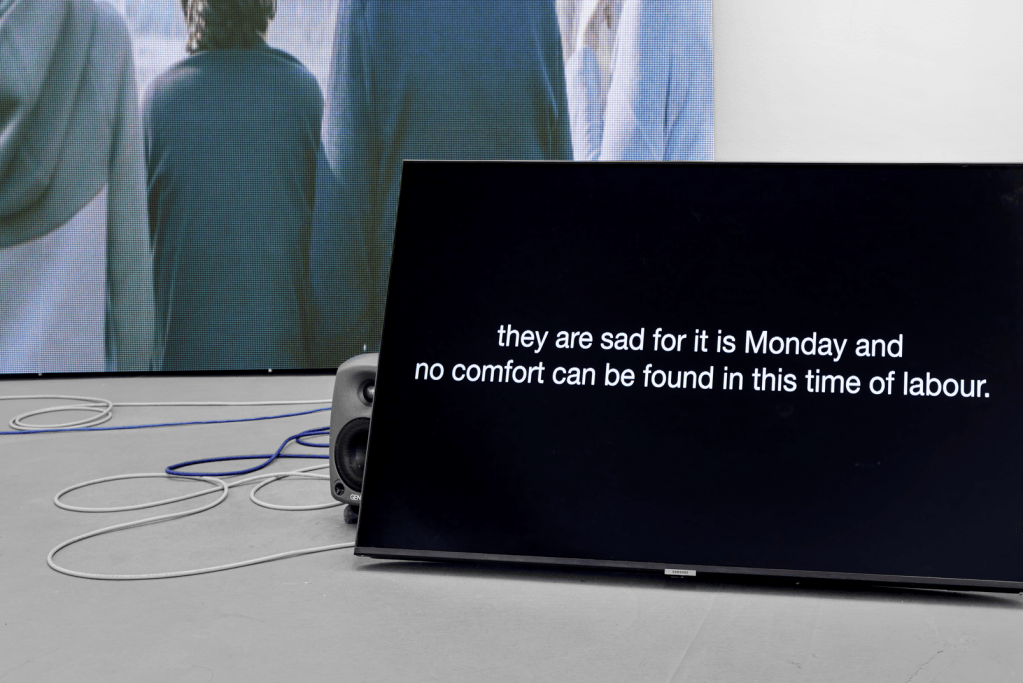
“What will be the price of this modernity?” The price of modernity is nostalgia.
The installation is accompanied by a deeply nostalgic soundtrack: the sound of a chitarra battente, composed by Renato Grieco. Its rhythmic presence adds another sensory layer to the work, intensifying the atmosphere saturated by nostalgia. But this is a false nostalgia—a nostalgia for a place that has never existed. A nostalgia of something never experienced. In Freudian terms, nostalgia can be understood as the rancour of what has been lost. Ultimately, that loss points towards the mother’s womb—the original state of being to which no return is possible.
In Nostalgism, Moccia shreds nostalgia as pathology and transforms it into method. Nostalgia, as a self-destruct button, is disarmed.


Leave a comment