13 November 2025
The Irish Museum of Modern Art (IMMA) in Dublin presents Reverse Migration, A Poetic Journey, the first solo exhibition in Ireland by artist, poet, and activist Cecilia Vicuña (b. 1948, Santiago, Chile).
This retrospective, mounted during the artist’s lifetime, brings together key works from Vicuña’s artistic trajectory, presented chronologically for an audience encountering a monographic exhibition devoted to her work for the first time. It also includes new works created during her return to Ireland, following her first visit to the island in 2006 with her partner, the Irish-American poet James O’Hern. That journey took the form of a ritual act of gratitude toward their Celtic ancestors, as they visited archaeological monuments across the island.
Among the highlights is Ongoing Quipu (2025), an installation commissioned by IMMA in which Vicuña merges her practice of basuritas and precarios with the quipu tradition. Found objects—native Irish flora donated by volunteer collaborators—float through the gallery space, suspended from the ceiling by fishing line.
Ongoing Quipu functions almost as a premonition of Vicuña’s wider practice: an infinite ecological sensitivity in which human beings are merely one component of a larger ecosystem, in an ecocritical sense not far removed from Donna Haraway. Here, waste—understood as failure within a consumerist and profit-driven system—recovers its dignity and value through an unwavering commitment to ecological justice.[1]
The adjoining galleries trace Vicuña’s artistic trajectory, beginning with her early work with the Tribu-No collective in Chile and the No-Manifiesto, before moving through her years in the United Kingdom, where she began her exile following Pinochet’s coup d’état, and later her return to the Americas, settling in Colombia.
The political and poetic force of her practice is particularly evident in her palabrarmas—works that transpose language into sculpture, performance, and visual poetry. They serve as a reminder of the power of words, especially within a dictatorship, where lies and defamation prevail.
The final retrospective gallery screens her short film shot on the streets of Bogotá in 1980, in which she asks passers-by a simple question: “What is poetry for you?”
Emerging from the darkened room, my eyes adjusting to the sudden brightness, I find myself face to face with Aran Quipu (2025), constructed from strips of undyed wool—much as Vicuña has done with other quipus, including her celebrated red Quipu Womb (2017). The corridor is so long that it echoes. The work is overwhelming: strip after strip of folded wool, each around two and a half metres high, occupies an immense hallway stretching some fifteen metres in length.
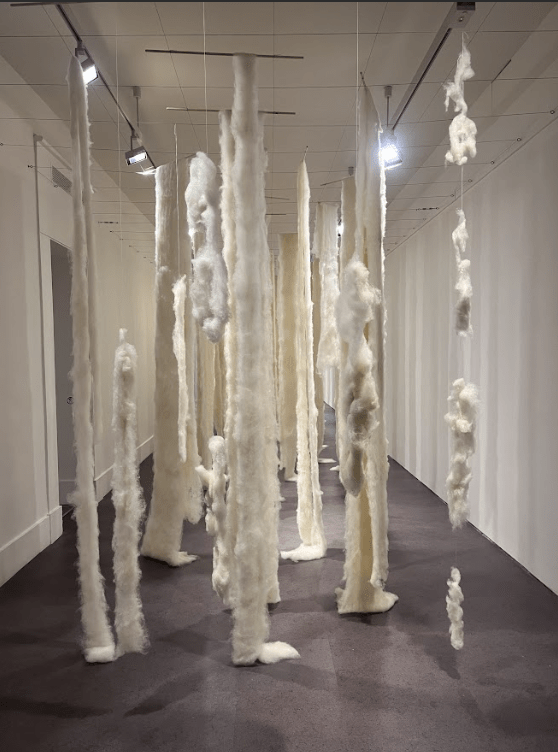
The wool was sourced from a cooperative in Galway, reflecting a desire to preserve the tradition and value of textile labour in the Aran Islands off Ireland’s west coast. Vicuña places her own Andean heritage in dialogue with Irish traditions, positioning Aran Quipu as the starting point for the exhibition’s second chapter: her poetic relationship with Ireland.
Before anything else, I want to highlight the wall text that Vicuña herself has written in chalk directly onto the museum wall—a gesture of profound intimacy between artist and viewer. I walk back and forth along the corridor, squeezed between the wall and the quipu. This is a work that demands observation. And stillness—lots of stillness.
The rooms branching off from the corridor present Vicuña’s extensive body of work inspired by this second journey to Ireland, particularly her engagement with the figure of the Sheela-na-gig—Romanesque stone carvings found on Irish church portals depicting female figures, often bald, openly displaying their genitalia with their hands.
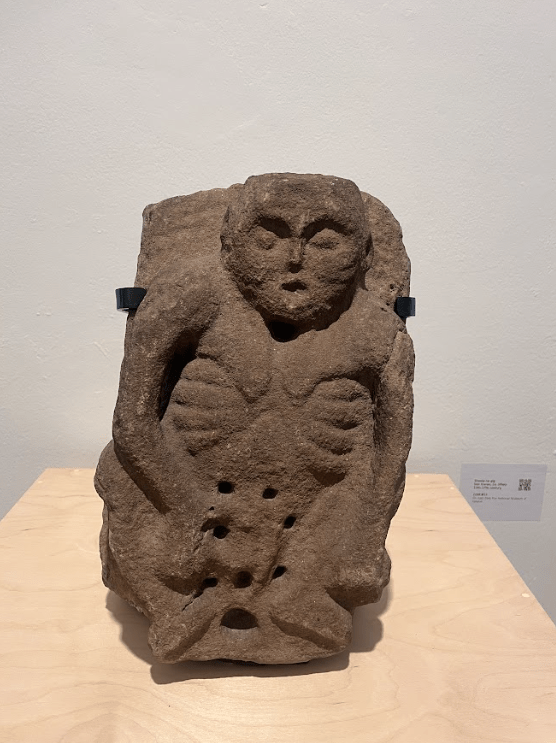
Historically, these figures have often been interpreted as fertility symbols. More recent scholarship, however, has challenged this reductive assumption and the persistent tendency—common enough within art history, medieval studies, archaeology, call it what you will—to assign maternal powers to any figure remotely associated with a vagina, even when there is neither a pregnant body nor a child in sight. The alternative interpretation, of course, is usually the prostitute, or the madwoman lifting her skirts to frighten men.[2] As we all know, women can only ever be mothers, whores, or lunatics.
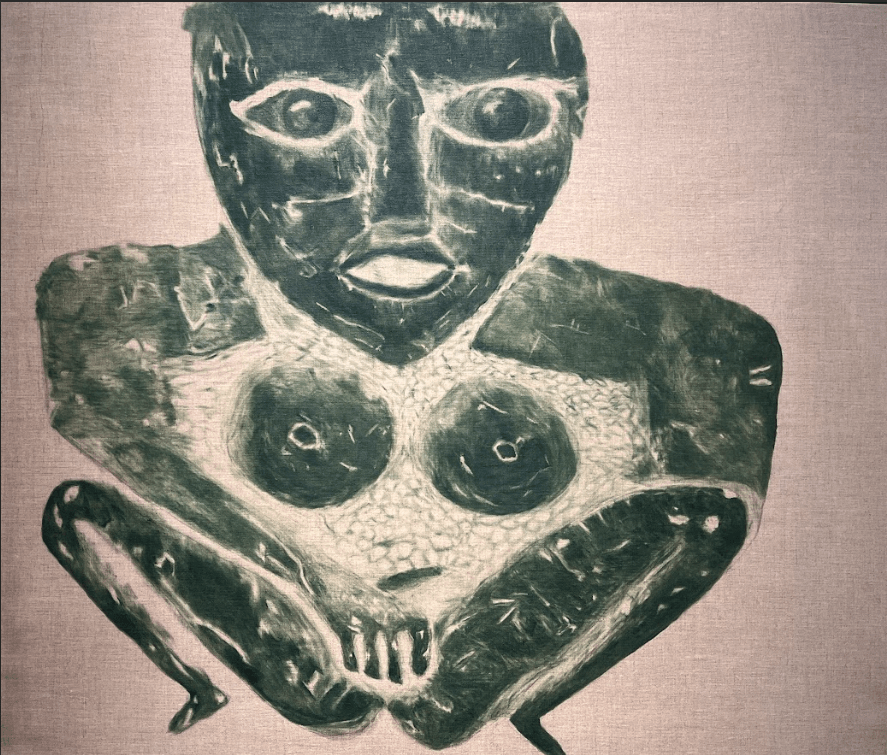
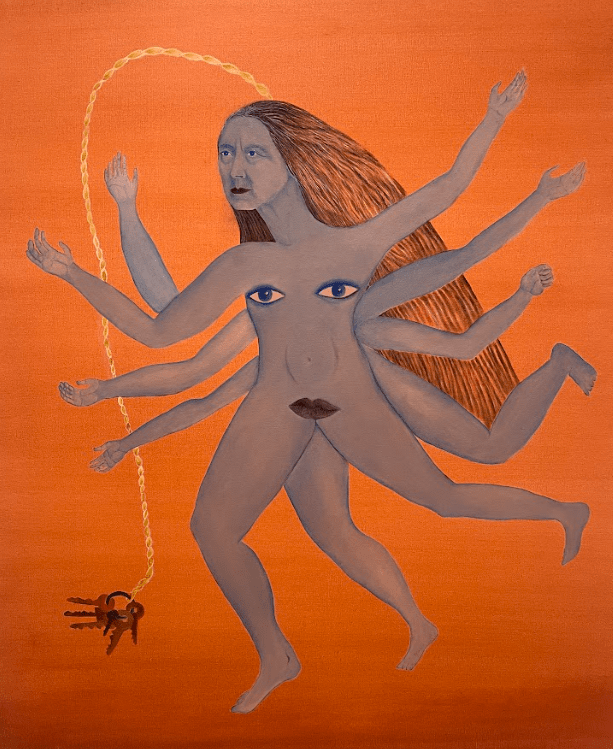
And this is precisely where Vicuña enters the conversation, offering a far more dignified reading of the Sheelas through a series of beautiful paintings. She retains the earthy colour of the original stone, departing from her more familiar chromatic palette, while incorporating the mythological feminism characteristic of some of her best-known portraits, such as Llavero, Ladilla, Crab (1979/2023) and La Comedora (1971/2019). Produced in recent years from sketches made during her travels through Brazil and the Amazon, the paintings also reveal the profound influence of Leonora Carrington during Vicuña’s time in Mexico.[3] The two artists previously shared exhibition space at the 2022 Venice Biennale, where I first encountered Vicuña’s work.
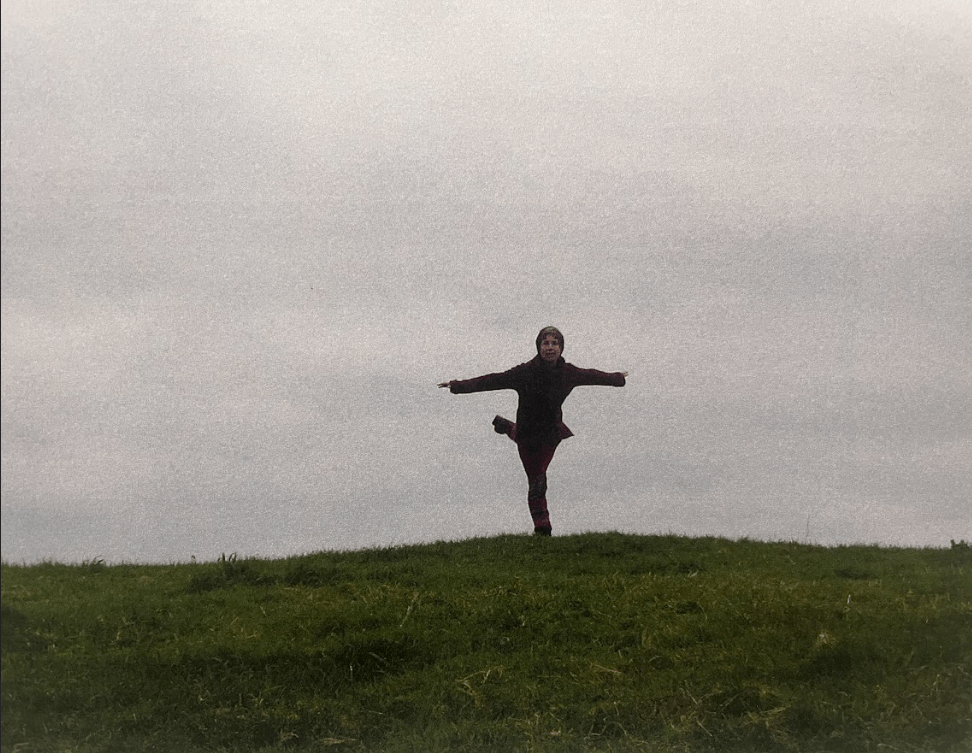
The exhibition becomes even more intimate through a sequence of personal photographs documenting Vicuña and O’Hern’s travels around the island. One image in particular captured my attention: Vicuña stands with one leg raised, her arms lifted into the air. It captures the spirit of the exhibition perfectly—everything feels so hippie, so peaceful, so happy.
The exhibition ends where it began: with an installation of basuritas, her beloved precarios. Visitors are invited to write the word “peace” in their mother tongue on wooden blocks using chalk. I write pau. I simply cannot resist writing—or doodling—in a museum when an artist asks me to. And, in part, this is Vicuña’s great achievement: she creates a genuine sense of proximity with her audience, something that many participatory artists only ever manage in the form of an aspiration.
In general, ecocritical, naturalistic, and environmentally themed exhibitions often leave me with a lingering sense of frustration. A problem is presented, the critique is articulated, and some vaguely defined alternative is proposed, leaving you with the feeling that the world is ending right this minute.
Reverse Migration, A Poetic Journey, however, radiates an absolute sensitivity toward both the self and the environment. It traces Vicuña’s artistic, poetic, and personal journey, in which the dignity of failure becomes an act of hope and an alternative to despair. Vicuña speculates, acts, and demonstrates; she is a scientific artist, and she does it all with love, rigour, and truth.
Reverse Migration, A Poetic Journey is on view at the Irish Museum of Modern Art (IMMA) in Dublin, Ireland, from 9 November 2025 until July 2026.
Translated into English by the author. Originally written in Catalan and published by HARTES.
[1] Miguel A. López, “Cecilia Vicuña: una retrospectiva para los ojos que no ven”, in Cecilia Vicuna. Veroír el fracaso iluminado, ed. Miguel A. López (MUAC, Museo Universitario Arte Contemporáneo, UNAM, 2020), 22-23.
[2] Georgia Rhodes, “Decoding the Sheela-na-gig,” Feminist Formations, 22, no. 2, (2010): 176.
[3] Leonora Carrington enjoyed her own retrospective individual show at IMMA in 2013. Similarly to Vicuña’s, focused on her Celtic symbolism and mysticism influence in her work, connected with her Irish-born mother.


Leave a comment