Published by HARTES no. 4 December 2025
Ireland’s art biennial, EVA International, is celebrating its 41st edition this year in the city of Limerick, located in the southwest of the island. EVA has collaborated with 13 cultural venues and art galleries to present a group exhibition featuring 22 national and international artists under the curatorial title It Takes a Village, co-directed by EVA’s steering committee and guest curator Eszter Szakács.
The small city of Limerick witnessed one of the most iconic moments in modern Irish history. In 1919, during the War of Independence, Limerick declared itself a soviet—an autonomous workers’ government. Phons O’Mara, mayor of the soviet, remarked in an interview with the American press that Limerick had no intention of becoming socialist, “because the people here are Catholic.”[1]
O’Mara’s words—anecdotal and amusing—point to one of the major contradictions that would shape Irish national identity following the speech of the country’s first prime minister, Éamon de Valera, who proclaimed a free, republican, and Catholic Ireland: a nation built, he proudly stated, collectively.
With this brief overview of the communal history of southwest Ireland, I want to introduce the curatorial programme of the 41st edition of EVA International, It Takes a Village, a title drawn from the saying “it takes a village to raise a child.” Szakács invokes collectivity as the methodological axis around which the artists and artworks revolve—rather than adopting a thematic framework, as many biennials do. The project is rooted in Ireland’s strong history of collective action while placing it alongside international examples. Szakács first encountered this curatorial approach at Documenta 15 through the Indonesian artists’ collective ruangrupa, and now brings it to Ireland’s biennial.
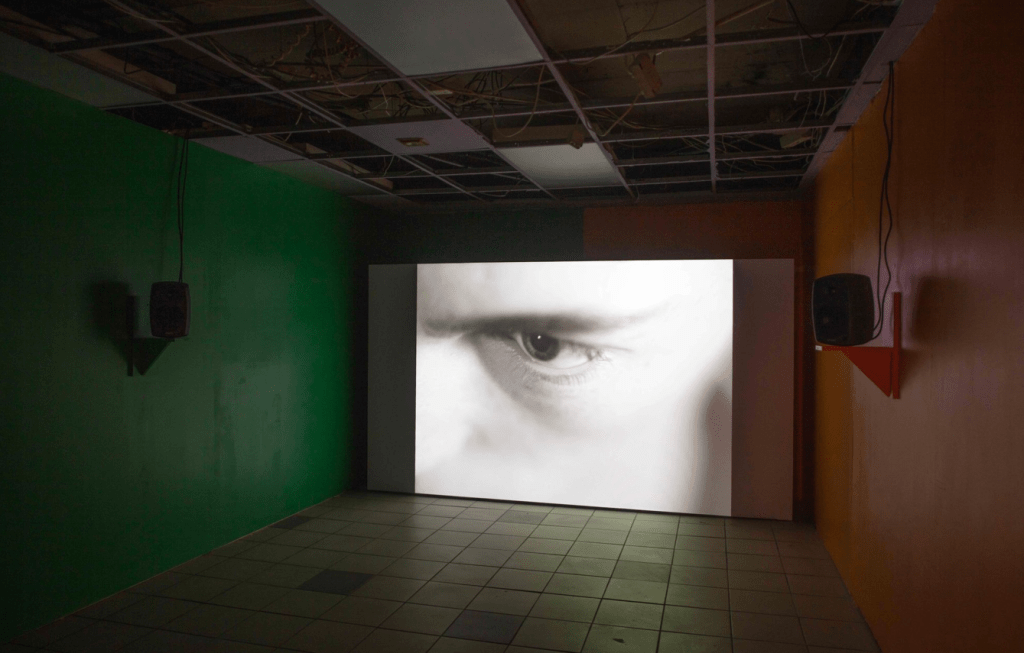
The exhibition route begins with the international artists at the Limerick City Gallery of Art, where Ana Bravo-Pérez presents If We Remain Silent (2023), an exquisitely delicate installation in which collectivity takes the form of textiles embroidered by a group of women with the names of Afro-Colombian and Indigenous social and environmental leaders. The same group appears in film performances projected with analogue cinema projectors, whose reels endlessly feed in and out of themselves. The film strip extends across the walls, forming the peaks of graphs displaying statistics on the murders of environmental activists.
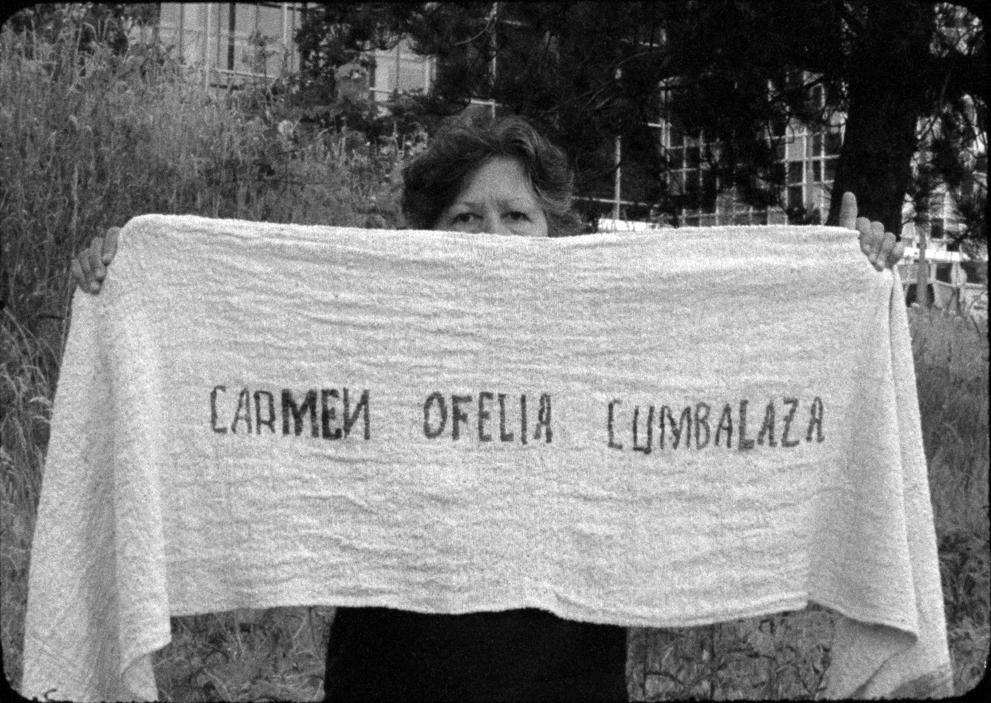
Next door, Marwa Arsanios presents her ongoing research project Who Is Afraid of Ideology? (2017–ongoing), documenting an experiment on expropriated land in northern Lebanon that seeks to revive the Mashaa, an Islamic practice of collectively working the land. Against expropriation and privatisation, the Mashaa becomes an act of collective resistance and a struggle for land rights.
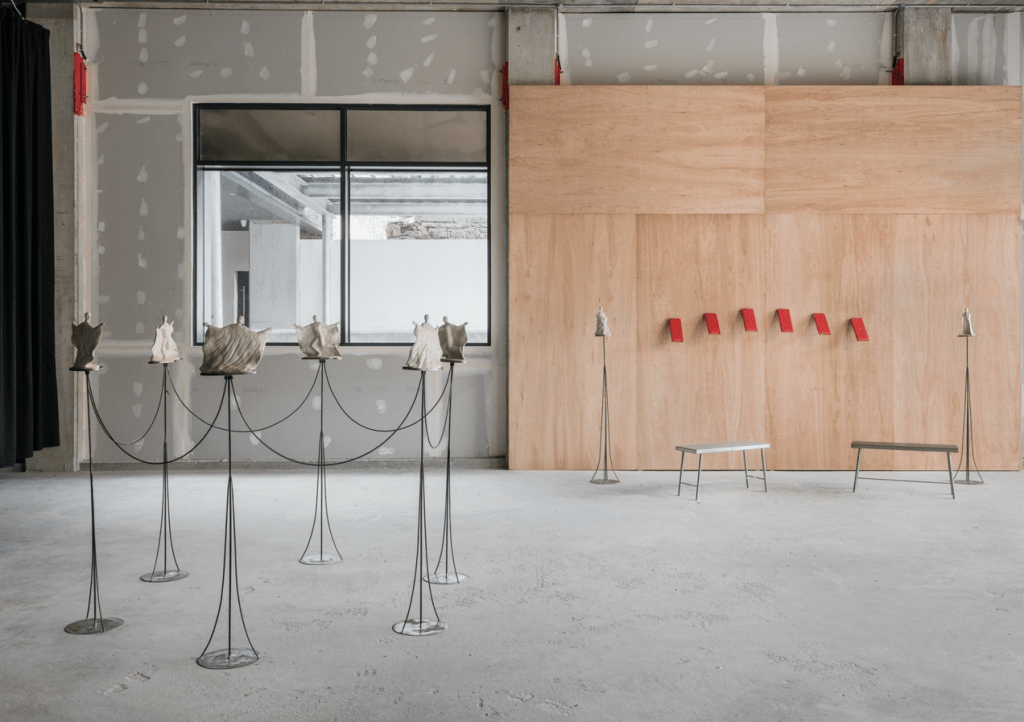
At One Opera Square, Gideon Horváth presents The Most Dangerous Person (2025), a work gathering the experiences of seven LGBTQ+ working-class people from rural Hungary, where they are regarded by their communities as “dangerous” individuals. Visitors can read interview transcripts—enough to turn your stomach—accompanied by exquisitely crafted ceramic sculptures embodying different stages in the interviewees’ lives: fear, shame, humiliation, dance, and freedom. The installation is completed by an explanatory video by Horváth.
The following two rooms also feature video works—let there be no misunderstanding: I have nothing against video art, I am all for it, but it does begin to wear thin. Many thanks to the gallery assistant who offered us stools so we wouldn’t have to sit on the floor for the next forty minutes of the short film. Have you ever been in Limerick in October, inside an unheated concrete building?
At this point the Irish artists enter the picture, and I begin to detect a thematic—or rather, methodological—shift linked to growing social concerns around national identity.
We begin at Ormston House with the group exhibition Bíodh Orm Anocht (“Stay with Me Tonight”), which seeks to recover Celtic iconography lost between colonialism and the Americanisation of the island—a topic I am most concerned and fascinated about. Seán Hannan’s Lucky (2022) revives piseógs—curses cast using eggs—while Laura Ní Fhlaibhín’s horses Bob and Alannah (2025) —an animal deeply embedded in Ireland’s historic horse-racing culture— shape salt blocks with their tongues. These blocks are attached to ash branches, a tree closely associated with protective talismans in Celtic mythology.
With Carceral Jigs (2025), Eoghan Ryan examines the contradictions of Irish nationalism through James Connolly’s revolutionary warning: “Let no Irishman throw a stone at a foreigner; he will surely hit one of his own.”[2] The video work combines footage from children’s television—the nostalgia card: an infallible technique for appealing to national sentiment—with recent images of far-right and anti-immigration protests across the island. Unfortunately, such movements have escalated dramatically in recent years, alongside racially motivated hate attacks.[3] [4]
The collective Éireann and I—an archive documenting Black migrant experiences in Ireland, founded by Joselle Ntumba and Beulah Ezeugo—poses a radical question: what happens when we listen to and pay attention to realities different from our own? A question so simple yet inexplicably challenging for today’s society. Their installation Call Centre Sound Structure (2025) imagines a fictional call centre where visitors can listen to three Black women workers narrate their experiences of labour, precarity, and racial discrimination in Ireland, particularly in the current climate.
And let us not forget another form of violence: housing.
EVA International has revived Eimear Walshe’s masterpiece Romantic Ireland (2024), first presented last year at the Venice Biennale’s Irish Pavilion. The multichannel video work was filmed using four second-hand mobile phones and features an original opera as its soundtrack. It depicts a group of nineteenth-century young farmers wearing green latex masks, dancing on the mud of land expropriated by speculative English landlords. Before long, the dance turns violent: the struggle over ownership has begun.
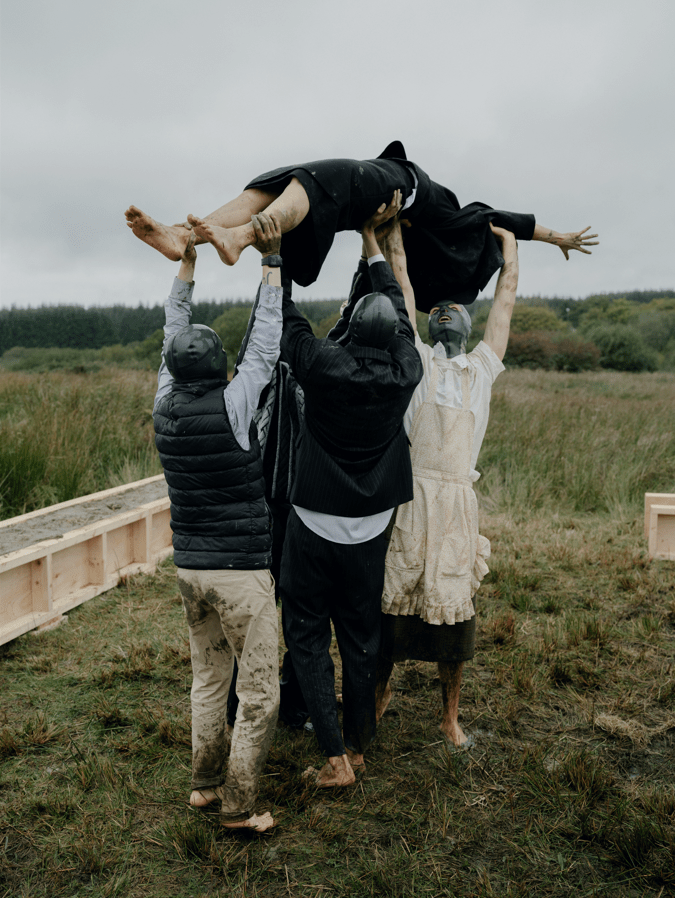
Nineteenth-century Ireland endured one of the harshest episodes of British imperialism during what is commonly known as the Great Irish Famine (An Gorta Mór)— “so-called,” as Sinéad O’Connor once remarked.[5] During this period, English landlords expropriated and privatised rural lands, displacing families and entire communities accustomed to the meitheal, a collaborative agricultural practice in which farming communities worked the land together seasonally. Forced displacement, starvation, and mass emigration to America caused a demographic collapse from which Ireland has yet to fully recover.[6]
Walshe connects these events from two centuries ago to today’s housing and social crises, shaped by neoliberal policies, vulture funds, and the Irish government’s international entanglements. The artist makes it clear that Ireland is no romantic paradise: the country has yet to come to terms with the open wounds of colonialism, while simultaneously opening new wounds elsewhere through criminal complicity. In this regard, the southwest of the island, where the artist comes from, has much to answer for.
Just over twenty kilometres from Limerick lies Shannon Airport. Since 1990, the airport has served as a stopover point for American military aircraft, troops, and weaponry en route to conflicts in the Gulf, Afghanistan, Iraq, Syria, and Palestine, as well as military operations involving Bulgaria, Germany, and Poland, among others.[7] At the same time, the Irish government condemns the genocide in Gaza, openly supports the Palestinian people, and prides itself on its neutrality in international conflicts. Something does not add up.
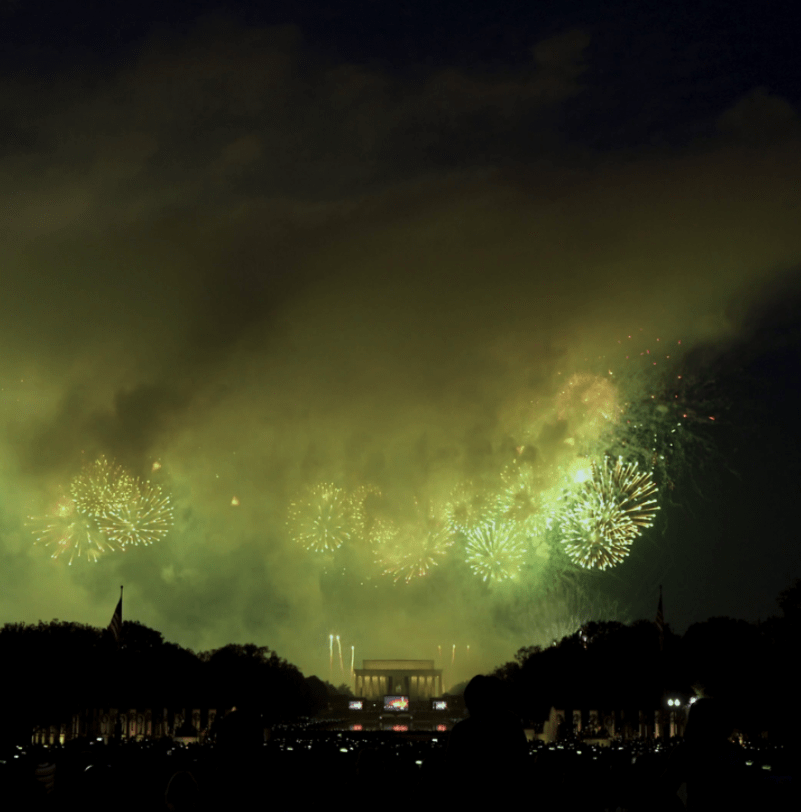
Artists Ruth Clinton and Niamh Moriarty, whose long careers have explored Irish identity and the country’s international complicities, present indirect fire (2025). A screen loops footage of a fireworks display at the White House, accompanied by a text recounting Ireland’s (in)direct role in enabling American funding of international wars. I find Clinton and Moriarty’s presence a key element to the biennial: they evidence the tense Irish paradigm of facing the trauma of postcolonialism while participating in third parties’ colonialisms, an alarming factor of contemporary Irish (identity) politics.
The biennial has undeniable value in addressing one of the most alarming issues facing Irish society in recent years: the brazen rise of xenophobic violence. The Irish artists acknowledge complicity without lapsing into self-flagellation, grounding their reflections in a past shaped by imperialism.
I share—and appreciate—the discourse articulated by the 41st edition of EVA. However, the curatorial results fail to fulfil the ambitious promises made at the outset. The exhibition is particularly weak in its selection of media: the lack of variety is criminal—video, video, video, sculpture, and then more video, video, video.
Nonetheless, I find it difficult to view Szakács’s methodological experiment as a success. Collectivity is undoubtedly one of the greatest acts of resistance, and international artists such as Bravo-Pérez demonstrate this power compellingly.
The international works neither converse with one another nor with the Irish contributions, resulting in a biennial that, far from demonstrating collectivity, feels more like two independent exhibitions operating under separate curatorial programmes. Many of the selected works are excellent; it is simply a pity about the overcrowded agenda.
The 41st edition of EVA International in Limerick ran from 29 August to 26 October 2025. A guide to the programme is available through the EVA International online archive.
Translated into English by the author. Originally written in Catalan and published by HARTES.
[1] Maurice Walshe, Bitter Freedom: Ireland in a Revolutionary World 1918-1922 (Faber & Faber, 2015), 135.
[2] “Let no Irishman throw a stone at the foreigner; he may hit his own clansman” from Aindrias Ó Cathasaigh (ed.), James Connolly: Lost Writings (Pluto Press 1997), published at Marxist’s Internet Archive, https://www.marxists.org/archive/connolly/1908/01/harpa.htm
[3] John Crofton, “Indian Trinity Students Raise Concern Over Recent Racist Attacks,” University Times, 27 August 2025, https://universitytimes.ie/2025/08/student-concerns-raised-over-the-wellbeing-of-indian-people-nationwide-in-light-of-recent-racist-attacks-tallaght-trinity-immigration-hate
[4] Patricia Devlin, “Around one in three hate incidents reported to gardaí are racially motivated”, The Journal, 17 September 2025, https://www.thejournal.ie/racist-attacks-ireland-6817334-Sep2025
[5] In Famine (1994) Sinéad O’Connor challenges the term “famine” used to describe a period during which much of Ireland’s food production was exported to Great Britain, depriving the access of the Irish population of access to its own resources and contributing to widespread starvation across the island.
[6] One of the slogans adopted by Ireland’s far-right movement is “Ireland is full”, a phrase borrowed from Donald Trump supporters. Ironically, as noted by The Irish Times, Ireland remains decades away from recovering the population levels it had before the nineteenth-century famine. https://www.irishtimes.com/opinion/2024/07/19/ireland-isnt-full-our-population-could-surpass-its-pre-famine-peak-in-33-years/
[7] This information is provided by ShannonWatch, a public campaign with the aim to end the use of Shannon Airport by the US military and to hold the Irish government and the airport authorities accountable for their involvement in human rights abuses and war. The organisation opposes to Ireland’s participating in any sort of military alliance, including the UN and the OTAN. ShannonWatch organises every second Sunday afternoon a demonstration in front of the Shannon airport. To learn more visit https://www.shannonwatch.org


Leave a comment