Published by Emblecat. Journal of Studies of Image, Art and Society
31 January 2025
KEYWORDS – Mary of Egypt, Byzantine, gender, masculine, feminine, sainthood, holiness, anchoress
ABSTRACT – Byzantine pictorial cycles in churches follow a strict, well-planned theological symbolism. Not everyone can be a painter, nor can a painter paint whatever they wish. Nevertheless, orthodoxy gets questioned with paradigmatic figures such as Mary of Egypt: a woman saint represented in Byzantium as any other male anchorite saint. Her figure conveys questions of gender and sainthood, subverting the wrongful idea of Catholic binarism, which orthodoxy seems to dismantle with Mary of Egypt. Although the legitimacy of her figure is under scrutiny, Mary of Egypt is a significant subject of study for both artistic and social purposes. As Jeannete Lindblom states: “even the lives of purely fictional saints reveal a lot about society, religion, culture and so forth, and about the social and political history of the period”.[1]
Saint Mary of Egypt—also known as Mary the Egyptian—was a fourth-century penitent saint and desert ascetic. Her life was recounted by the priest Zosimas, whose testimony was later recorded by Saint Sophronius in the sixth century. Sophronius’ account constitutes the earliest surviving hagiographical text dedicated to Mary of Egypt and appears in the Vita tradition associated with Cyril of Scythopolis, c. 550.
Whether Mary of Egypt was a historical figure or a literary invention remains uncertain. Her story has long been questioned by scholars, who have noted significant parallels with the lives of Saint Paul of Thebes and Saint Jerome.
What is certain, however, is the profound impact her figure had on ascetic practices, beginning within Palestinian monasticism and eventually spreading throughout the Christian East. Her cult achieved remarkable popularity across the Byzantine Empire, where numerous chapels were dedicated to her, including one within the Church of the Holy Sepulchre, where she is believed to have begun her path of repentance after encountering an icon of the Virgin Mary.[2] The saint’s image circulated as a model of virtue and asceticism, as a significant Eucharistic symbol during periods of theological controversy, and, above all, as one of the most striking female figures in the history of Byzantine art.
Mary of Egypt became deeply embedded within Byzantine society as an exemplary model of ascetic practice.[3] Like the holy men of the desert, she was admired for her virtue. Yet, as a woman, she differs substantially from other female saints such as Marina, Agatha, or Catherine, whose sanctity is achieved through physical martyrdom. Mary of Egypt, by contrast, undergoes a martyrdom of the soul. Her life embodies what Lynda Coon describes as “the capacity to teach Christian audiences that redemption is possible even for the most contemptible sinners”.[4]
Mary of Egypt personifies female sexuality—insatiable and sinful—subjected to the discipline of both body and soul imposed by a predominantly male religious institution.[5] She becomes a symbol of penitence, conversion, and the Eucharist. Byzantine painters took advantage of these associations to depict her in monumental church decoration both as a monastic ideal and as a model of Christian responsibility for the faithful, particularly regarding the proper reception of communion.[6]
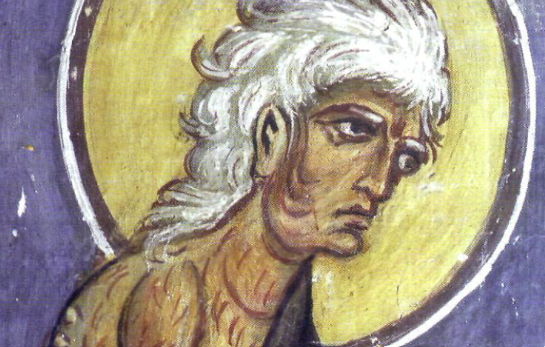
The iconography of Saint Mary of Egypt differs radically from that of most Byzantine female saints (Fig. 1). To modern viewers, the absence of expected markers of femininity in representations of Mary of Egypt is striking because of its apparent gender ambiguity. Indeed, her figure can easily be mistaken for that of her fellow male penitential saints.
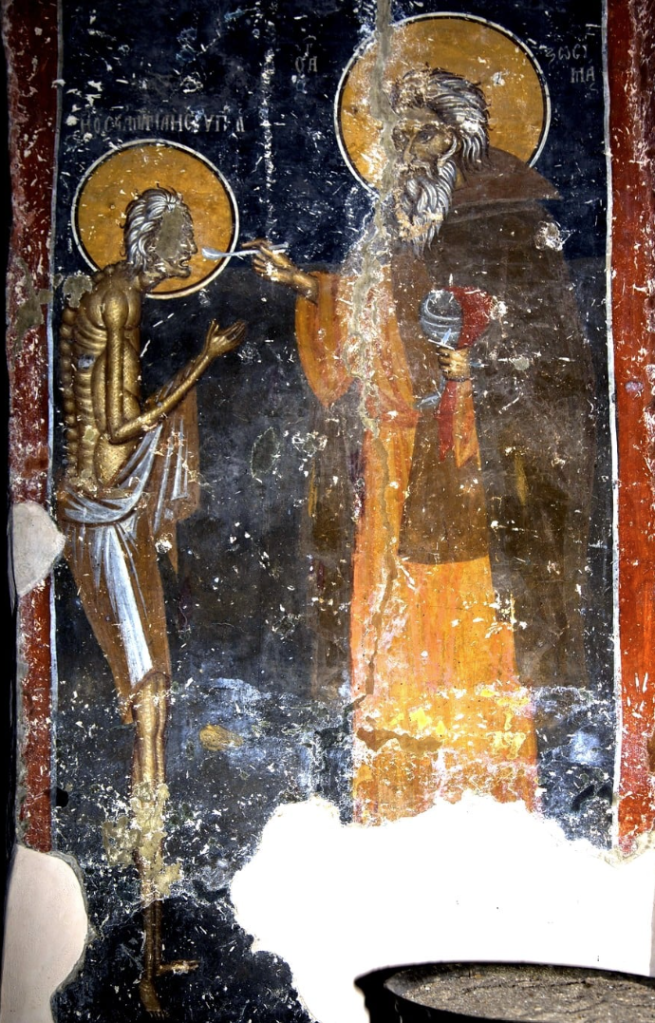
The feature that distinguishes Mary from other ascetic male saints—and therefore the final vestige of “femininity” that allows her to be identified as a woman—is the absence of a beard, a conventional iconographic marker of masculinity.
Her physical appearance is defined by extreme asceticism. She is depicted as emaciated, with ribs and spine visible beneath her skin; frail and hunched; with sparse white hair; darkened by the desert sun; her skin wrinkled and weathered, and her face devoid of any trace of sensuality.
In general terms, Mary of Egypt’s image may be described as grotesque and masculinized. Biological and hormonal factors must also be taken into account. The saint’s prolonged fasting would likely have led to amenorrhea,[7] given that she embarked upon her penitential life while still young. Such conditions would have produced physical effects including hair loss, increased body hair, dry and wrinkled skin, and the loss of secondary sexual characteristics such as breasts and bodily curves.
One particularly interesting interpretation is proposed by Roland Betancourt, who characterizes Mary of Egypt’s body as “transmasculine”,[8] due to its resemblance to the male body.[9] Betancourt further identifies what he interprets as signs of a mastectomy, arguing that surviving Byzantine medical texts document gender-reassignment surgical procedures and describe both the incision and resulting scar associated with mastectomy. According to Betancourt, similar scars can be observed on representations of Mary of Egypt, as well as on depictions of Saint Agatha, whose breasts were removed during her martyrdom.[10]
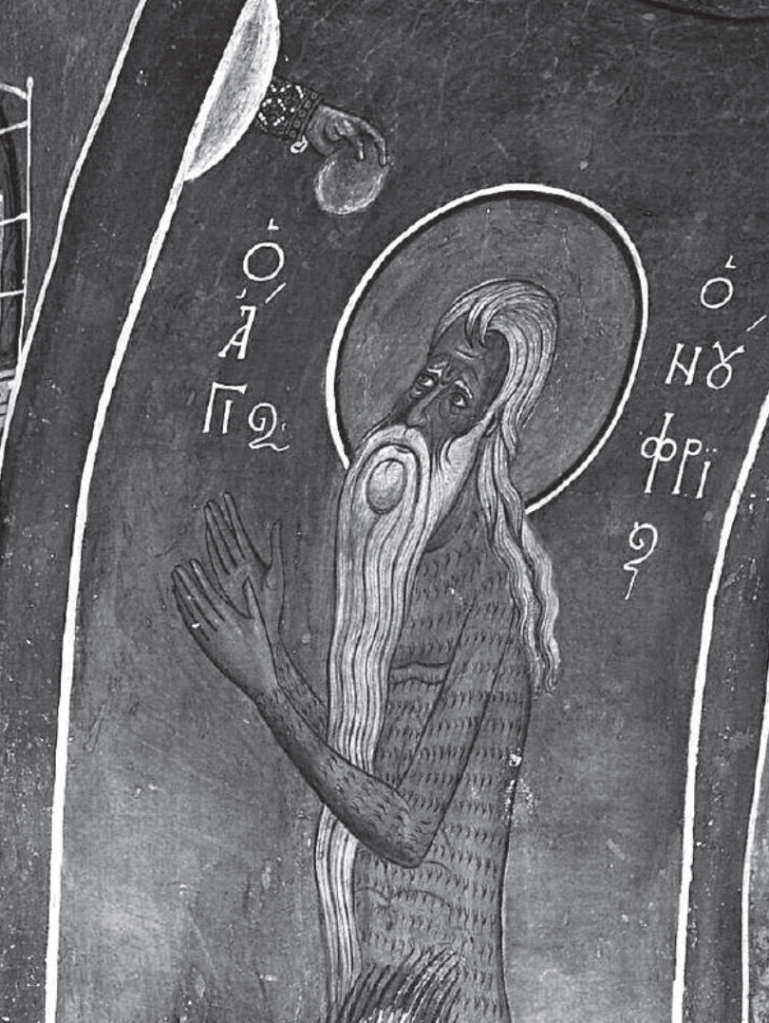
The iconography of Saint Mary of Egypt constitutes a paradigmatic case within Byzantine art. From the twelfth century onward, her appearance became highly standardized and immediately recognizable among the many figures depicted on church walls. Most saints, monks, and Church Fathers are identified through inscriptions bearing their names. Unlike Western Catholic iconography, Byzantine art generally avoids extensive use of individual iconographic attributes, with a few notable exceptions such as Saints Barbara and Catherine, identified respectively by the tower and the wheel.[11] Mary belongs instead to the group of penitential saints and desert ascetics. Comparable figures include Saint John the Baptist and Saint Onuphrius (Fig. 2), both recognizable through their distinctive appearance: abundant hair and beards, simple clothing, and emaciated bodies that signify a life of rigorous asceticism.
Mary of Egypt is distinguished from these male ascetics only by the absence of a beard, an image entirely removed from that of her female counterparts.[12] Put differently, the figure of Mary of Egypt functions as a “masculine counterpart to male monks: emaciated, incorporeal, a shadow projected alongside all the holy bishops, who, like the monastic saints, were expected to display qualities of immateriality and incorporeality in their images.”[13]
Manuel Philes, the thirteenth–fourteenth-century poet from Ephesus, observed that the saint’s unusual representation was often intended to discomfort the viewer in order to emphasize her ascetic condition and rejection of carnal pleasure.[14] Philes writes:
“O painter, your hands have painted the shadow of a shadow;
for the body of the Egyptian woman was but a shadow.
Or rather, to speak more precisely,
from a shadow you have painted material suffering.”[15]
In Byzantine Intersectionality: Sexuality, Gender, and Race in the Middle Ages (2020), Roland Betancourt proposes an intersectional approach to Byzantine art history. Following Kimberlé Williams Crenshaw’s definition (1989),[16]: “marginalized people exist at the intersection of multiple factors. Intersectionality examines how overlapping social identities create unique conditions of inequality and oppression.”[17] In short, Betancourt advocates approaching history through the interconnected lenses of gender, sexuality, and race.
He begins his analysis with the example of Saint Mary of Egypt (Fig. 2), depicted in the Church of Panagia Phorbiotissa at Asinou, Cyprus.[18] Mary appears in the scene of the Communion of Zosimas, with both figures represented on individual pillars.[19] What particularly interests Betancourt is her relationship to the adjacent image of the Virgin Mary and John the Baptist.[20]
Betancourt argues that while Mary of Egypt is represented as a male ascetic, contrary to conventional feminine characteristics—breasts, long hair, fair skin, long garments, and so forth—John the Baptist is depicted in a somewhat feminized manner. Although he possesses a beard, dishevelled hair, and appears as a desert ascetic, Betancourt maintains that his representation contains more feminine than masculine characteristics:
“By Byzantine standards, John’s body is more feminine than Mary’s, or, perhaps more accurately, Mary’s body is more masculine than John’s. John’s hair is longer than Mary’s, extending far beyond his shoulders and falling in lustrous curls. Mary’s tunic lies as flat across her chest as John’s lies across his; a slight swirl of colour beside her armpit may allude to withered breasts (…). On her face, the weight of excess flesh and wrinkles traces the line of Mary’s jaw. The smooth, rounded face of the Virgin standing beside John offers a striking contrast: the ascetic possesses no such roundness (…). Mary’s jaw presents a strong and prominent chin, unlike the Virgin’s soft, rounded features. (…) John’s legs, arms, and feet are covered with body hair, indicated by fine, elongated black brushstrokes. Mary’s body is marked by similar lines, though thicker and shorter (…). Her flesh likewise appears covered with body hair. In this ambiguity between scar and hair, the wounds of asceticism are transformed into the secondary sexual characteristics of the male body.”[21]
John the Baptist is therefore a significant figure through which to examine Mary of Egypt as her counterpart, given his status as a male saint intimately associated with femininity through his constant proximity to the Virgin Mary. [22]
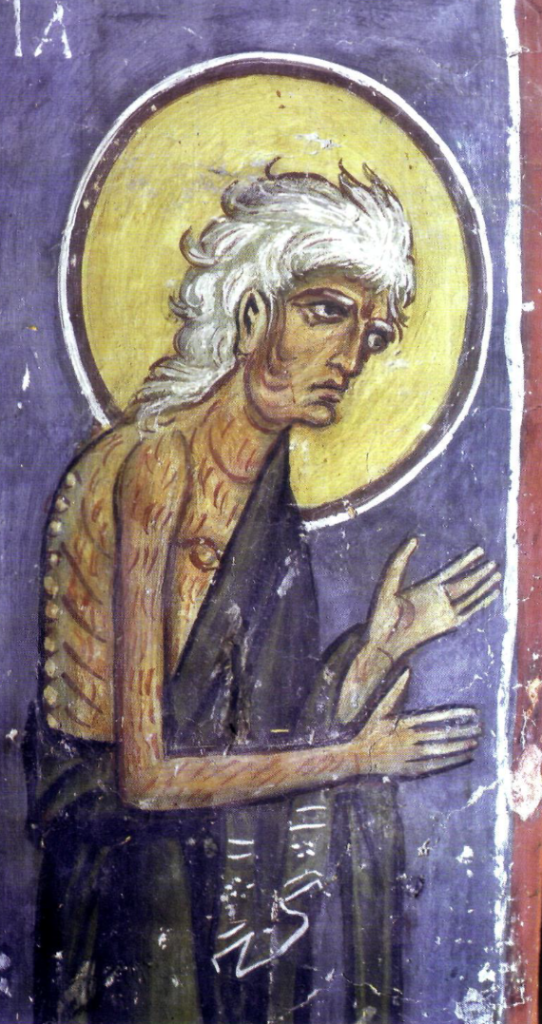
Regarding Mary’s dark complexion, Betancourt further argues that a racial perspective is necessary, one that is implicitly linked to gender. Throughout early Eurasian civilizations, distinctions between men and women in art were often expressed through skin colour: women were represented with lighter skin and men with darker tones. Mary of Egypt, however, is canonically depicted with dark skin. We may recall Zosimas’ description of her as a woman whose “skin was darkened by the sun of the desert.”
Aetius of Amida, the fifth-century physician and scholar, claimed that dark-skinned women were inherently aggressive and masculine.[23] [24] Here, intersectionality becomes particularly relevant, as questions of gender are inseparable from questions of race, and vice versa.
Ultimately, Betancourt presents Mary of Egypt as a compelling figure through which to examine the role of gender, sexuality, and race in Byzantine society. Her pictorial representation departs significantly from conventional depictions of female saints; her transformation entails a renunciation of her role as an object of male desire, within a worldview that regarded women as both the origin of sin and inherently lustful; and her dark skin was associated with masculinity and virility. Through her figure, it becomes possible to undertake an intersectional reading of Byzantine society.[25] As Elisabeth Schüssler Fiorenza argued in 1983, “If the teachings of Jesus had been put into practice, patriarchy would have come to an end.”[26]
It should also be noted that dark-skinned women have historically been characterised as masculine, aggressive, and hypersexualized. Dark skin was frequently associated with sensuality and, consequently, with uncontrolled desire. Such assumptions call for a critical historical reassessment of the patriarchal, class-based, and racial logics that produced them.
Despite this, Byzantine society took considerable care to maintain women in a subordinate position within the social hierarchy. Nevertheless, women occupied roles every bit as significant as those of their male counterparts and participated actively in society. They served as physicians, merchants, agricultural workers, theologians, and historians; they founded churches and monasteries, composed hymns and poetry, participated in politics, and, on occasion, ruled the empire itself.[27]
Saint Mary of Egypt constitutes a paradigmatic example of a woman capable of mastering her supposedly lustful and sinful nature while embracing a way of life identical to that of any male ascetic. What distinguishes her from other female saints is her renunciation of femininity and her embrace of the virility associated with a disciplined and controlled mind through:[28] ““the rejection of pleasure and the denial of the flesh.”[29]
While, like most penitential female saints, she practised fasting and subsisted solely on the Eucharist, saints such as Clare of Assisi, Catherine of Siena, and Elizabeth of Hungary were devoted women from childhood or adolescence, choosing early in life to renounce the flesh. Mary of Egypt, by contrast, converts much later, after a life governed by carnal desire. A sinful life redirected toward holiness through a decisive moment of transformation is a pattern far more characteristic of male saints, such as Ambrose and Augustine of Hippo.[30]
Socially, women were believed by nature to possess stronger sexual desires and carnal appetites. Consequently, their primary moral task was understood as learning to control their emotional and sexual impulses. Stories of women—saints, ascetics, and penitents—who demonstrated sufficient strength to overcome these instincts were greatly admired, often through practices of fasting, self-denial, and bodily suffering.[31] When women exhibited such capacities for self-control, they were regarded as masculine and exemplary.[32]
Likewise, surviving treatises on human biology indicate that men were thought to possess bodies that were naturally hard and dry, whereas women, children, and eunuchs were considered naturally soft and “moist.” Consequently, their diets were also expected to consist of foods that were mild and cooling.[33] Thus, when Mary of Egypt is depicted as a “dry” person, with hardened and wrinkled skin, sustained by coarse and desiccated foods, her image stands in stark contrast to medieval conceptions of gender.
For the Byzantines, gender functioned as a hierarchy of virtue: first men, then eunuchs, and finally women. In other words, a virtuous person was one who could perform masculinity through emotional restraint, mastery of desire, rational conduct, and self-control.[34] Masculinity was rooted in “the effort to escape sin.”[35] The supreme example of virtue—the price paid for attaining sanctity—was the annihilation of the female body: “repentance leads to conversion and represents the mechanism through which the rejection of female nature as inherently sinful is enacted.”[36]
Female saints were therefore required to renounce their femininity, not only because it was associated with sinfulness, but also because it was considered physically and morally inferior to the divine superiority attributed to masculinity.[37]
In short, gender, masculinity, and femininity were not understood as fixed categories, but rather as behaviours that both men and women could—in Butlerian terms—perform and acquire through their lived experiences. Gender thus possessed a degree of fluidity across different bodies and social roles:[38]
“Certain aspects of the Orthodox hagiographical tradition testify to the fact that the body, what it signifies, and how it relates to socially constructed gender expectations could be dynamically reconfigured in the service of Orthodoxy. Gender appears to function as a flexible and historically contingent means of communicating sanctity rather than as an essentialist category tied to prescriptive behaviours based upon one’s bodily form.”[39]
When a woman such as Mary of Egypt behaved “virilely” or “like a man,” she did not thereby become a man, as contemporary assumptions might suggest. Rather, she ascended socially through the acquisition of virile qualities: thinking, acting, and writing as a man.[40]
Caroline Walker Bynum was highly critical of this framework. She emphasized that the lives of female saints were written by men and that these women were described as “virile” insofar as they imitated the lives of male saints. They were interpreted through a process of “gender reversal” whenever they adopted male roles in order to achieve what only men were thought capable of achieving. Yet, as Bynum argues, these women continued to understand themselves as women and, at most, as androgynous figures.[41]
If we approach gender through contemporary frameworks, particularly the queer theories of Judith Butler, such ascetic women as Mary of Egypt would not, strictly speaking, qualify as women, since they rejected virtually all the obligations traditionally associated with womanhood: marriage, childbearing, nurturing and caring for the family, remaining within the domestic sphere, and so forth. If we interpret the past exclusively through present-day categories, then indeed they were not women. However, if we seek to understand the past on its own terms—before gender was conceptualized as performative in the modern sense—these figures remained women. Non-normative women, certainly, because they were masculine, virile, and virtuous. Yet women nonetheless.
In this sense, “by depicting women saints in masculine terms, hagiographers sought to demonstrate a position of power achieved through sanctity, a status otherwise unimaginable for women.”[42]
Indeed, Mary of Egypt herself appears conscious of her inferior social position when she presents herself humbly before Zosimas. When the priest asks the saint to guide him spiritually, acknowledging her superior holiness, Mary initially refuses, insisting that she is unworthy even of being looked upon. She apologizes for her audacious presence before the priest.[43] Meanwhile, Zosimas admires her, treating her as one of the Church Fathers—a wise authority capable of teaching him the word of God. Mary ultimately offers him a prayer, thereby revealing her sanctity.
Purpura (2020: 660) proposes an insightful interpretation of saints such as Mary of Egypt as figures who negotiate gender roles and hierarchies. Through the saint, attributes are exchanged and social roles inverted, yet always within the doctrinal boundaries permitted by Orthodox tradition.
The central question raised by Mary of Egypt, therefore, concerns the lens through which we examine her relationship to gender. The twentieth-century feminist theorist Luce Irigaray demonstrated, drawing upon Aristotelian philosophy, that distinctions between men and women were structured through the exclusion of women from the formation of late antique and medieval Western rationality:[44]“Christianity contributed decisively to perpetuating the idea, deeply rooted in Greco-Roman society, of woman’s fundamental inferiority.”[45]
Ruth M. Karras defends the scholarly use of modern terminology concerning gender and sexuality in the study of the premodern past, provided such categories are applied carefully and not merely imposed as contemporary inventions: “We cannot simply apply modern sexualities to medieval people;[46] we cannot assume that sexualities existed because they are universal; nor can we deny the existence of sexuality because it is a nineteenth-century invention.”[47]
Roland Betancourt proposes the term “transgender saints” for those women who “transformed” themselves into men in order to escape female inferiority and embrace masculine superiority—that is, self-control, asceticism, and virtue.[48] He argues in favour of employing modern terminology because categories such as transgender are no more anachronistic than labels such as transvestite, gender reversal, or cross-dressing, terms that have been used throughout historiography with little critical reflection to describe individuals who deviated from normative gender and sexual expectations.
Betancourt maintains that modern terminology can help articulate, in a coherent manner, the processes of gender transformation and sexual reconfiguration documented in the Byzantine world. He supports this position by pointing to the existence of medical treatises describing sex-reassignment procedures and mastectomies, as well as autobiographical texts by figures such as the imperial philosopher Michael Psellos, who described himself as a woman born in a man’s body.[49]
A broad use of queer terminology is advocated in order to bring to the table and properly define the “complexity of gender variance and nonconformity in Byzantium.”[50] When discussing Mary of Egypt, she is analysed through her characteristic “transmasculinity.”[51] Furthermore, Betancourt adds that if we opt for an exclusive use of primary sources—which are based on the explicit oppression and discrimination of certain groups—as scholars we become “(trans.) apologists of social inequality and oppression (…)”[52] “Marginalisation, oppression and intersectionality are not modern constructions: they are methodologies. Even if this self-critical language is not found in the primary sources, we cannot claim that these lives are not valid. To say that this is anachronistic or contrary to the historian’s project is to be complicit in oppression.”[53]
The question of the most appropriate terminology to use in academia when addressing issues of gender and sexuality remains unclear. In any case, we see that Byzantine society was not indifferent to these questions: “(trans.) the most interesting thing about these texts [Basilakes’ text] is the awareness that people may have sex but behave according to a different gender.”[54] It was a society concerned with ensuring that everyone strictly followed established gender norms. Likewise, they ensured that textual and visual traces of gendered performative incongruities were preserved in famous figures of their time.[55]
The Orthodox tradition includes in its hagiographies examples of holy women who altered sociobehavioural expectations of masculinity and femininity, demonstrating the diversity “(trans.) in which sanctity allowed the transgression of the limits imposed by those expectations.” These texts reject a singular and generalised model of sainthood and instead recognise, through dynamic portrayals, that God is present, powerful, transformative, and liberating in women’s lives.[56]
However, we might still question why she is represented in such a “grotesque” way. Patricia Cox argues that this reflects the early Christians’ difficulties in representing female sanctity. Although the figure of the saint is likely an isolated case among female saints, her representation must have been clearly established from the outset: the ascetic lifestyle of the desert, like that of other monks and ascetics, turns Mary of Egypt into an equal among other male ascetics. Consequently, her pictorial representation follows the same iconographic pattern: Mary of Egypt reproduces the modes of ethical subjectivation established by Byzantine theology, which is thoroughly masculinised.[57]
Authors such as Clare Lees and Diane Watt see in the transcendence of Mary of Egypt’s “femininity and fiscality” when she retreats into the desert an act that is “transgendered or genderqueer.”[58] In this way, they propose her figure as an example of dissidence from gender roles. Similarly, Betancourt suggests treating Mary of Egypt’s body as “transmasculine,” without attributing to her the category of a trans man.
However, as Leonora Neville has shown, Mary of Egypt acts virtuously and ascetically as a monk, as a man, while still being aware of her role as a woman: she refuses to let Zosimas see her; her penance stems from her lived experience as a sexually active woman. She does not renounce womanhood in order to become a man; she renounces corporeality. Therefore, she does not transform but rather transcends.
We have seen that gender in Byzantine times is not a categorical binary. There is flexibility and an exchange of masculine and feminine traits between men and women. There is room for negotiation between what is masculine and feminine, and everything in between. Nevertheless, it is certainly not a utopian society of gender equality; on the contrary, anyone who behaved in a feminine way would be degraded, regardless of whether they were male or female.
Therefore, when we encounter figures with such complex gender performativity as Mary of Egypt, it is easy to spill rivers of ink trying to define a coherent gender classification. After all, in the words of Alicia Spencer-Hall, “(trans.) gender is a river. And it never stops flowing.”[59]
The figure of Saint Mary of Egypt cannot be placed alongside other penitent saints such as Barbara, Cecilia, Agnes, or the Western Mary Magdalene. Nor can she be placed alongside desert saints and monks such as Saint Onuphrius, Gregory, or John the Baptist. Both groups display clearly defined gender roles within the traditional Orthodox context. At first glance, Mary of Egypt might appear to be a dissident of tradition. However, she does not in any way see herself as a deviation: she identifies as a woman and responds as such in the presence of a man. Nevertheless, as Purpura (2019) indicates, Mary of Egypt negotiates, exchanges, and adapts gender roles between masculinity and femininity depending on context.
In short, my proposal is to understand the artistic representation of Saint Mary of Egypt not as a gender dissidence—since she neither subverts roles nor challenges the status quo—but as an unusual form of confirmation of the flexibility of gender performativity in Byzantium. It is precisely the adaptation to context and its gendered characteristics that reaffirm the gender roles represented in Byzantine art. Mary of Egypt is a saint because she is both female and virile. In other words, the aim of the article is to invite new perspectives on the representation of gender in the medieval period, questioning the entire patriarchal historical layer that has rendered invisible practices that exceeded Orthodox normativity. In this way, a new range of gender-informed possibilities is offered, allowing us to approach historical iconographies. This reveals the fragility of the canonical narrative, offering a critical perspective on it, with its contradictions, paradoxes, and inconsistencies.
BIBLIOGRAPHY
Betancourt, R. (2020), Byzantine intersectionality: sexuality, gender, and race in the Middle Ages. Princeton University Press, Princeton, New Jersey.
Bynum, C. (1991), Fragmention and Redemption: Essays on Gender and the Human Body in Medieval Religion. New York: Zone Books.
Bynum, C. (1987), Holy Feast and Holy Fast: The Religious Significance of Food to Medieval Women. University of California Press, Berkeley.
Bynum, C. (1982), Jesus as Mother: studies in the spirituality of the High Middle Ages. University of California Press, Berkeley.
Dumitrescu, I. (2018), “Desire: The Life of St Mary of Egypt”. In The Experience of Education in Anglo-Saxon Literature, (ed.) Irina Dumtriscu, 129-156. Cambridge University Press, Cambridge.
Franco, L. (2021), “Byzantine Lives: Discussing Nonbinary Sexuality, Gender and Race in Byzantium”, Harvard Theological Review 114 (4), p. 561-570.
Jantzen, Grace M. (1995), Power, Gender and Christian Mysticism. Cambridge University Press, Cambridge.
Karras, R. (2017), Sexuality in Medieval Europe: doing unto others. New York Routledge, London.
Lidov, A. (1991), The Mural Paintings of Akhtala. Nauka Publishers, Moscow.
Lindblom, J. (2019), Women and públic space. Social codes and female presence in the Byzantine urban society of the 6th to the 8th centuries. Helsinki University: Helsinki, doctoral thesis.
Maguire, H. (1996), The Icons of Their Bodies: Saints and Their Images in Byzantium. Princeton University Press, Princeton, New Jersey.
Neville, L. (2019), Byzantine Gender. Amsterdam University Press, Amsterdam.
Palacio, M. (2004), “¿Qué tiene para decirle M. Foucault al Cristianismo? Prólogo a una genealogía de género de la moral sexual cristiana”, Pensamiento 60 (228). p. 413-422.
Purpura, A. (2020), “Innovating “traditional Women’s Roles: Byzantine Insights For Orthodox Christian Gender Discourse”, Modern Theology 36 (3). p. 641-661.
Tatarchenko, S. (2012), “(trad.) The Communion of Venerable Mary of Egypt in Byzantine monumental painting”, Vestnik PSTGU, Serie V 1 (7). p. 24–50.
Sofroni. Vie de Sainte Marie Égyptienne pénitente / par Sophrone. Suivie de Vie de Saint Syméon Stylite / par Théodoret de Cyr (trad. Arnauld d’Andilly), Montbonnot-St. Martin: Jérôme Millon, 1985.
Waldstein, M., Wisse, F. (eds.) (1995), The Apocryphon of John: synopsis of Nag Hammadi codices II,1; III,1; and IV,1 with BG 8502,2. Brill Publishers, Leiden. Watt, D. & Lees, C. (2011), “Age and Desire in the Old English Life of St Mary of Egypt: A Queerer Time and Place?”. In Middle-Aged Women in the Middle Ages, (ed.) Sue Niebryzdowski, 53-67. Woodbridge, Suffolk: D. S, Brewer.
NOTES
[1] Lindblom, J. 2019: 43. Women and public space. Social codes and female presence in the Byzantine urban society of the 6th to the 8th centuries. Helsinki University, doctoral thesis.
[2] In the Byzantine Empire, devotion to the icon of the Virgin Mary was very important, and through it people would ask her for guidance and advice in order to follow the right path. Therefore, it is part of Eastern culture to be able to “speak” with the Virgin Mary through the icon (Online Orthodox Encyclopedia, vol. 43, p. 547). For more information about the “speaking” icon of the Virgin Mary, see Lidov, A. “Iconos milagrosos de Santa Sofia.”
[3] “(trad.) What characterises monastic asceticism is a total break with the world and with its systems of values based on urban civilisation, which had been largely assimilated by official Christianity. This break takes the form of a withdrawal from the world in order to devote oneself to a life of profound asceticism in the desert.” (Palacio, “¿Que tiene…”, p. 415)
[4] Dumitrescu, I. 2018: 147. “Desire: The Life of St Mary of Egypt”, in The Experience of Education in Anglo-Saxon Literature. Cambridge University Press, Cambridge.
[5] Ibid.
[6] Svetlana Tatarchenko, “(trad.) The Communion of Venerable Mary of Egypt in Byzantine monumental painting.”, Vestnik PSTG 1 (7) (2012), p. 27.
[7] A common symptom among people with restrictive eating disorders who menstruate occurs when the hypothalamus fails to respond adequately to low energy availability due to malnutrition. As a result, the body suppresses menstruation, leading to hormonal imbalance. This may in some cases be associated with altered androgen levels, which can contribute to features traditionally classified as “masculine” characteristics.
[8] Although she is described as having a transmasculine body, this does not determine her gender identity as that of a transgender man. In any case, Betancourt argues that her representation is thoroughly masculinised.
[9] Later on I will address the similarities with the figures of Saint Onuphrius and Saint John the Baptist.
[10] Roland Betancourt, Byzantine intersectionality: sexuality, gender, and race in the Middle Ages, (Princeton, New Jersey: Princeton University Press, 2020), pp. 7-11.
[11] Henry Maguire, The Icons of Their Bodies: Saints and Their Images in Byzantium, (Princeton, Nova Jersey: Princeton University Press, 1996), p.27.
[12] Ibid., p. 28.
[13] Ibid., p. 77-78.
[14] Ibid., p. 79.
[15] Maguire, “The Icons”, p. 74.
[16] Kimberlé Crenshaw, “Demarginalizing the Intersection of Race and Sex: A Black Feminist Critique of Antidiscrimination Doctrine, Feminist Theory and Antiracist Politics,” University of Chicago Legal Forum 140 (1989), p. 139–67.
[17] Betancourt 2020: 14.
[18] Ibid., 6.
[19] It follows a characteristic 12th-century iconographic pattern in which the scene is divided by columns and door frames, symbolising an entry into or welcome to the Eucharist.
[20] The familial bond between John the Baptist and the Virgin Mary is sealed: “When Jesus saw his mother and, standing beside her, the disciple whom he loved, he said to his mother: ‘Woman, here is your son.’ Then he said to the disciple: ‘Here is your mother.’” (Jn 19, 26-27).
[21] Betancourt 2020: 6-7.
[22] Like Saint Sebastian, Saint John the Baptist is considered by certain LGBT groups to be a “gay” icon, a biblical representation of male homosexuality. His often effeminate pictorial representations, as well as his close and intimate relationship with Jesus, have historically raised questions about the nature of their relationship, leading to debates about the sexuality of John the Baptist and of Jesus himself. For more information: Scott Tucker, The Queer Question: Essays on Desire and Democracy (South End Press, 1997); Eusebius of Caesarea, Ecclesiastical History Book iii, Ch. xxiii; Martti Nissinen, Homoeroticism in the Biblical World: A Historical Perspective, (Fortress Press, 2004);Sjef van Tilborg, Imaginative Love in John, (Brill, 1993); Dynes, Wayne R. Encyclopedia of Homosexuality, (Taylor & Francis, 2016).
[23] Betancourt 2020: 14.
[24] Today, there is still a racist and misogynistic attitude towards Black American women, known as the “angry Black woman” stereotype, which portrays them as aggressive and masculine. For more information: Wendy Ashley, “The angry black woman: the impact of pejorative stereotypes on psychotherapy with black women”, Social Work in Public Health 29 (1) (2014): 27-34. A recent study of it impact in workplace: Motro, D., Evans, J. B., Ellis, A. P. J., & Benson, L., III (2021), “Race and Reactions to Women’s Expressions of Anger at Work: Examining the Effects of the “Angry Black Woman” Stereotype”, Journal of Applied Psychology (2021).
[25] Betancourt 2020: 2.
[26] Grace M. Jantzen, Power, Gender and Christian Mysticism (Cambridge: Cambridge University Press, 1995), p. 48.
[27] Leonora Neville, Byzantine Gender (Amsterdam: Amsterdam University Press, 2019), p. 59.
[28] Ibid., p. 23.
[29] Marta Palacio, “¿Qué tiene para decirle M. Foucault al Cristianismo? Prólogo a una genealogía de género de la moral sexual cristiana”, Pensamiento 60 (228), (2004), p. 415.
[30] Caroline Walker Bynum, Holy Feast and Holy Fast : The Religious Significance of Food to Medieval Women (Berkeley: University of California Press, 1987), pp. 24-25.
[31]Neville, Byzantine Gender, p. 36.
[32] Ibid., p. 37.
[33] Ibid., p. 24.
[34] Ioannes Kaminiates (Xth century): an authoritative man becomes “effeminate” when he is taken captive, as the loss of dominance and control over his life results in the abandonment of masculinity. This weakness is closely associated with the femininity of women. (Neville, Byzantine Gender, p. 45).
[35] Neville 2019: 49.
[36] Laura Franco, “Byzantine Lives: Discussing Nonbinary Sexuality,Gender and Race in Byzantium”, Harvard Theological Review 114 (4) (October 2021), p. 568.
[37] Ibíd., p. 569.
[38] Neville, Byzantine Gender, p. 60.
[39] Ashley Purpura, “Innovating “Traditional Women’s Roles: Byzantine Insights For Orthodox Christian Gender Discourse”, Modern Theology 36 (3), (2020), pp. 657
[40] Neville 2019: 63.
[41] Caroline Walker Bynum, Fragmentation and Redemption: Essays on Gender and the Human Body in Medieval Religion, (New York: Zone Books, 1991), pp. 36-37.
[42] Purpura, “Innovating”, p. 657.
[43] Ibid., p. 660.
[44] When Religion is based on texts written by the elite (men), they (men) are the only ones with authority to access, create and disseminate knowledge. (Jantzen, Power, Gender, p. 64).
[45] Palacio, “¿Que tiene…” p. 418.
[46] Laura Franco writes a review on Betancourt’s book and pinpoints an idea R.Karras had already highlighted: “Of course, we are not denying the possibility of the existence of a Christian queerness (160), which seems detectable in many of the examples Betancourt selected. The point is that this queerness cannot be demonstrated on the grounds of a sometimes slightly arbitrary reading of the sources” (564).
[47] Ruth M. Karras, Sexuality in Medieval Europe: doing unto others, (London: New York Routledge, 2017), p. 33.
[48] Betancourt 2020: 90-98.
[49] Ibid., p. 114.
[50] Betancourt 2020: 120.
[51] Ibid., p. 5.
[52] Ibid., p. 208.
[53] Ibid., p. 130.
[54] Ibid., p. 119.
[55] Neville 2019: 94.
[56] Purpura 2020: 661.
[57] Palacio 2004: 419.
[58] Watt, D. & Lees, C. 2011: 53. “Age and Desire in the Old English Life of St Mary of Egypt: A Queerer Time and Place?” in Middle-Aged Women in the Middle Ages, ed. Sue Niebryzdowski, (D. S, Brewer, Woodbridge, Suffolk, 2011).
[59] Alicia Spencer Hall, communication at Gender and Sainthood 1000-1500ca. [conference] (Oxford: Oxford University, 2024).
Translated into English by the author. Originally written in Catalan and published by Emblecat.


Leave a comment