Published by HARTES
27 October 2023
Revised 4 March 2025
Irish Sign Language (ISL) is offered as an elective subject within the Humanities programmes at University College Dublin (UCD). When my roommate—now that I have become something of a Dubliner myself—first mentioned this to me, I was pleasantly surprised.
What is perhaps even more surprising is that ISL was not formally recognised by the Irish state until 15 December 2017, when the Irish parliament passed legislation granting it official recognition and establishing rights to its use in public services. This relatively recent recognition highlights the complex coexistence of two historically marginalised languages in Ireland: the Irish —long subjected to linguistic suppression— and Irish Sign Language, whose speakers have likewise struggled for recognition.
The question of linguistic preservation inevitably raises broader debates about identity and cultural heritage. ISL is particularly fascinating from a linguistic perspective because its historical development was shaped by gender segregation in Irish Catholic schools, resulting in distinct male and female signing traditions that influenced the language’s evolution.
These reflections provide context for Freude! Freude!, an installation by the Dublin-born artist Amanda Coogan (b. 1971), presented at the Douglas Hyde Gallery, Trinity College Dublin (11–29 October 2023). Developed in collaboration with Alvean Jones, Lianne Quigley, the Centre for Deaf Studies at Trinity College Dublin, and the Dublin Theatre of the Deaf, the project explores communication, accessibility, and collective belonging.
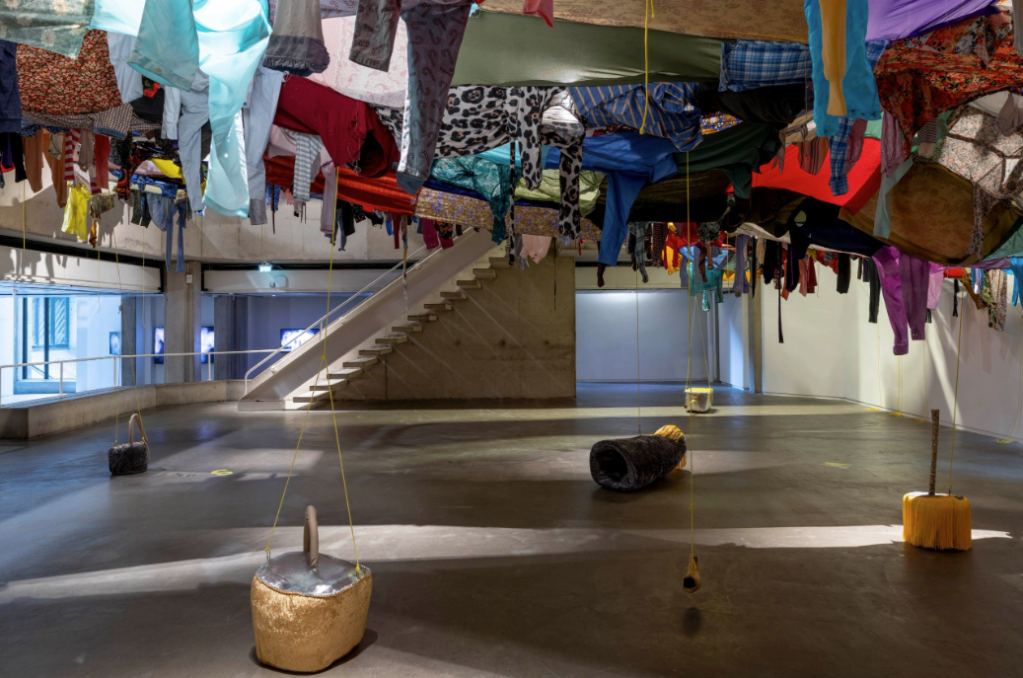
The installation consists of a suspended canopy formed from assembled garments whose fabrics create shifting patterns of light and shadow throughout the gallery. Textile and felt objects are hanging from pulley systems that evoke hearing aids from different historical periods. Beneath this canopy, six video screens continuously display footage of Coogan rehearsing an ISL interpretation of Beethoven’s Ode to Joy from the Ninth Symphony (1824)—a work famously celebrated by audiences despite the composer’s profound deafness.
Coogan’s performance interacts with the suspended objects and their changing play of light—I was lucky to see the artist herself activate the installation through a performance. The soundtrack alternates between Beethoven’s celebrated choral movement and an almost comic cacophony of Dublin street sounds: church bells, the screech of Luas trams, car horns, engines, footsteps, and pedestrian crossing signals. These contrasting soundscapes evoke two distinct yet interconnected experiences: that of an artist unable to hear her own work and that of a citizen unable to hear the city around her.
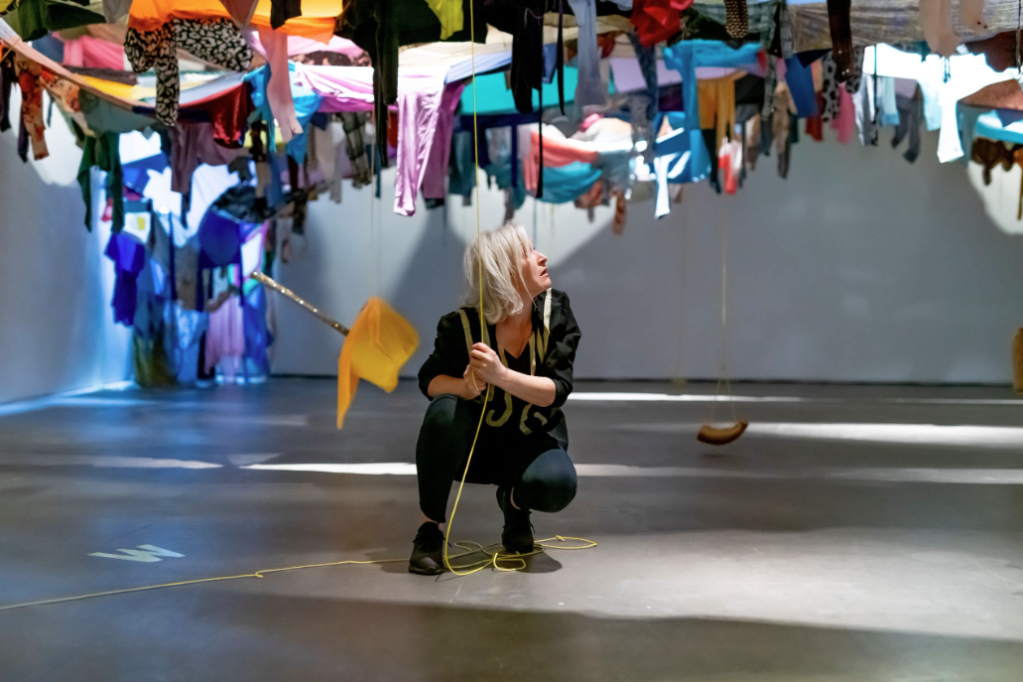
Coogan’s presence on screen is compelling, energetic, and expressive. Through movement and ISL, she draws attention to the challenges faced by deaf and hard-of-hearing people in environments designed primarily for those who can hear.
The installation communicates both hope and critique. The stitched garments suggest how individual lives, when joined together, can create a collective fabric capable of supporting and protecting its members. At the same time, the work serves as a reminder of the barriers that persist in societies insufficiently attentive to the needs of vulnerable communities. In this sense, Coogan pursues ideals often associated with Beethoven’s Ninth Symphony and its adoption as a symbol of European unity: harmony, peace, solidarity, inclusion, and mutual respect. Yet for Coogan, these ideals cannot remain abstract aspirations. They require concrete collective action.
As the Irish proverb reminds us:
Ní neart go cur le chéile.
Translated into English by the author. Originally written in Catalan and published by HARTES.


Leave a comment